 ultimate-guide
Tui Na for Sports Injury: Recovery Guide
Table of Contents
- What Tui Na for Sports Injury Treatment Involves
- Tui Na vs Sports Massage: Key Differences
- Which Sports Injuries Tui Na Can Help With
- Tui Na Recovery Time: What to Expect
- Gua Sha for Muscle Recovery and Soreness
- Who Should Avoid Tui Na: Safety and Contraindications
- Combining Tui Na with Modern Sports Science
- Frequently Asked Questions
Last Updated: September 18, 2026
What Tui Na for Sports Injury Treatment Involves
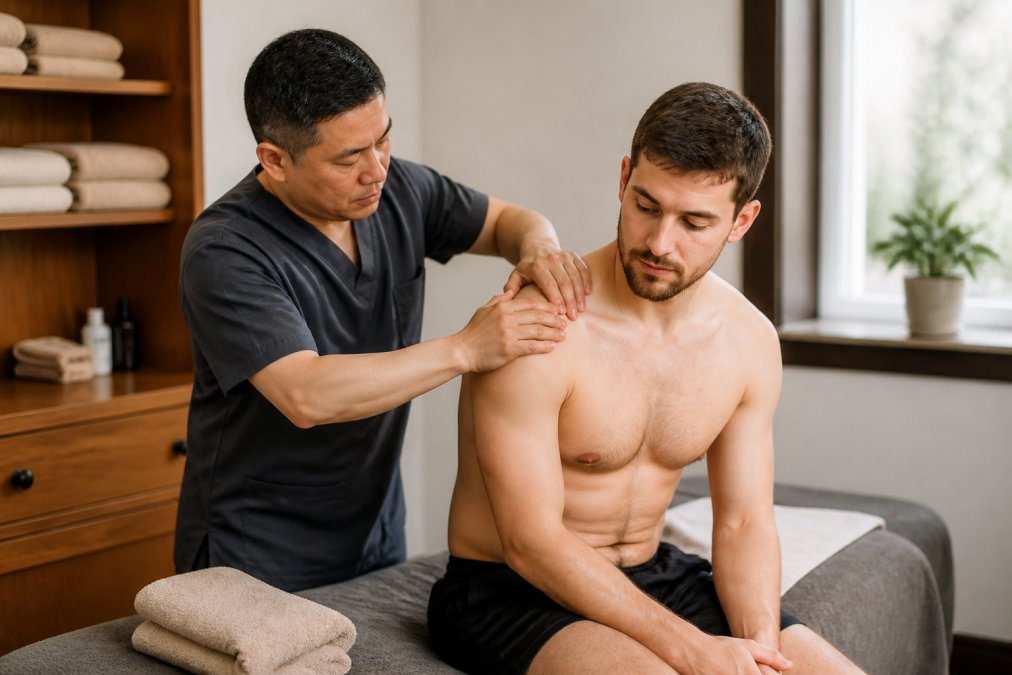
Tui Na for sports injury is a form of therapeutic bodywork from Traditional Chinese Medicine (TCM) that uses hands-on manipulation to address musculoskeletal problems, soft tissue dysfunction and restricted movement. At Lee Chinese Style Therapy Ltd, treatment begins with an assessment of how the injury happened, where movement is limited and which tissues are involved, then works through the affected area using rhythmic pressure, kneading and joint mobilisation.
How a Session Works
A typical session moves through three phases: lighter techniques to warm the tissue and assess its response, firmer kneading, rolling and acupressure to specific trigger points, then passive stretching and joint mobilisation to restore movement before the tissue cools.
Tui Na vs Sports Massage: Key Differences
Tui Na and sports massage overlap more than most people expect, but they come from different traditions. Sports massage is built around soft tissue release, myofascial work and recovery from training load. Tui Na adds a diagnostic framework from TCM, using meridians, acupressure points and qi flow to decide where and how to work.
Technique and Pressure Compared
| Feature | Tui Na | Sports Massage |
|---|---|---|
| Origin | Traditional Chinese Medicine | Western sports therapy |
| Main focus | Meridians, qi flow, joint mobility | Soft tissue, myofascial release |
| Pressure style | Rhythmic, varied, point-specific | Sustained, often broader strokes |
| Typical session | 30-60 minutes | 30-90 minutes |
| Best for | Specific injuries, chronic tension | General recovery, pre/post event |
Neither approach is automatically better. For broad recovery after a long training block, sports massage may suit you. For a recurring shoulder problem or long-standing neck stiffness that has not responded to other treatment, the point-specific nature of Tui Na is worth exploring.
Which Sports Injuries Tui Na Can Help With
Tui Na is most often used for soft tissue injuries and the muscular tightness that lingers after them. Runners, cyclists, swimmers and racket-sport players commonly seek treatment for:
- Strains and sprains in the calf, hamstring, ankle and wrist
- Post-exercise soreness that does not clear within a few days
- Trigger points causing referred pain in the shoulder or lower back
- Nerve compression symptoms such as tingling in the arm or leg
- Reduced range of motion after a period of rest or immobilisation
Tui Na Recovery Time: What to Expect
Most guides on Tui Na for sports injury avoid giving any timeline, leaving athletes unable to plan their return to training. Recovery depends on tissue type, injury stage and how consistently you follow aftercare, but useful benchmarks exist. What follows is a practical framework based on how practitioners typically stage treatment, not a guarantee.
Recovery Timelines by Injury Type
| Injury type | Typical session frequency | Expected response | Return-to-training guidance |
|---|---|---|---|
| Mild muscle strain (grade 1) | 1 session, review at 5-7 days | Reduced tightness and improved range within 24-48 hours | Light movement after 48 hours if pain-free; full load at 7-14 days |
| Moderate strain (grade 2) | 2-3 sessions over 10-14 days | Noticeable easing after the second session | Gradual loading from day 7, full load typically 3-6 weeks |
| Ankle sprain (grade 1-2) | 2-4 sessions over 2-3 weeks | Swelling and stiffness reduce steadily after the first week | Proprioceptive work from week 1; sport-specific from week 2-4 |
| Chronic tendinopathy | 4-6 sessions over 4-8 weeks | Slow, cumulative change; rarely dramatic after one session | Load management throughout; no complete rest |
| Post-exercise soreness (DOMS) | 1 session as needed | Relief within hours, peaks again at 24 hours | Train as normal if soreness is not limiting |
| Nerve compression (mild) | 3-5 sessions over 3-4 weeks | Tingling reduces gradually; may fluctuate | Avoid aggravating positions; nerve glides alongside treatment |
These are typical ranges, not promises. A recent, mild soft tissue injury responds faster than a problem built up over months. Chronic conditions need a longer, steadier course because the tissue has adapted around the dysfunction.
What Happens Between Sessions
Recovery is not just what happens on the couch. Aftercare in the 48 hours after a session directly affects how quickly you progress:
- Hydration: Drink water steadily for the rest of the day. Tui Na moves fluid through tissue, and dehydration slows that clearance.
- Gentle movement: Walk, swim or cycle lightly rather than resting completely. Blood flow supports tissue repair.
- Heat, not ice, for chronic tightness: Ice is for acute swelling in the first 48 hours (Ice and heat treatment). For long-standing tightness, warmth before gentle stretching is usually more useful.
- Sleep: Most tissue repair happens during sleep. Aim for 7-9 hours, especially in the first few days after a session.
- Avoid the aggravating load: If running caused the problem, do not run through it the next day. Cross-train instead.
When to Expect Slower Progress
Some patterns consistently take longer than athletes hope. Progress is slower if the injury is more than six weeks old, if you keep training at the same volume, if sleep or nutrition is poor, or if there is an underlying structural issue such as a labral tear or stress fracture that bodywork cannot address. Tui Na can still manage symptoms, but it will not resolve the cause alone.
A Realistic Course of Treatment
A common pattern is a short initial course: one session to assess and treat, a review at five to seven days, then a decision on whether to continue weekly, fortnightly or move to maintenance. Athletes in heavy training often benefit from a maintenance session every three to four weeks rather than waiting for a flare-up. The goal is to keep tissue mobile and catch restrictions early.
Gua Sha for Muscle Recovery and Soreness
Gua Sha is a related TCM technique that uses a smooth-edged tool to stroke the skin and underlying tissue, usually producing temporary redness. For muscle recovery, it is often used on the calves, thighs, shoulders and back to ease post-exercise soreness and support lymphatic drainage.
Who Should Avoid Tui Na: Safety and Contraindications
Most articles on Tui Na for sports injury skip this section, which is a problem because the techniques involve firm pressure over joints, nerves and blood vessels. A responsible practitioner screens every client before treatment. Contraindications fall into two groups: absolute, where treatment must not go ahead, and relative, where it may be possible with medical clearance or a modified approach.
Absolute Contraindications
Do not book Tui Na, and do not let a practitioner proceed, if any of the following apply:
- Suspected fracture, dislocation or complete ligament tear. Manipulation over an unstable structure can worsen the injury. This needs imaging and medical assessment first.
- Active infection, fever or contagious skin condition. Bodywork can spread infection and will make you feel worse.
- Open wound, burn, or recent surgical site. Direct pressure risks reopening tissue and introducing infection.
- Known bleeding disorder or current use of anticoagulant medication. Firm pressure can cause bruising or haematoma that will not resolve normally.
- Recent blood clot or diagnosed vascular condition. Mobilising a clot is dangerous. This is a hard stop.
- Severe osteoporosis or known bone metastases. The risk of fracture from manual pressure is too high.
Relative Contraindications
These do not automatically rule out treatment, but require a conversation with your practitioner and, in some cases, written clearance from your GP or specialist:
- Pregnancy, particularly the first trimester. Some acupressure points are traditionally avoided. Many practitioners will treat with lighter techniques and avoid the lower abdomen and lower back.
- Diabetes with peripheral neuropathy. Reduced sensation means you may not feel pressure that is too firm. Your practitioner should use lighter pressure and check in frequently.
- Varicose veins or lymphoedema. Deep strokes over affected areas are avoided; gentle lymphatic work may still be appropriate.
- Recent corticosteroid injection. Tissue is more fragile for around two weeks afterwards. Wait before treating the injected area.
- Acute inflammatory flare-up. In the first 48 hours of a fresh injury, when swelling and heat are present, treatment is usually modified or deferred in favour of rest, elevation and gentle movement.
- Cancer under active treatment. Requires oncology clearance. Some techniques are safe, others are not, and this is not a decision for a massage practitioner alone.
What to Do Instead
If Tui Na is not appropriate right now, that does not mean doing nothing. Depending on the reason:
- For acute injury, follow the standard early-stage approach: protect, elevate, gentle movement as tolerated, and seek medical assessment if you cannot bear weight or the joint feels unstable.
- For a suspected fracture or tear, go to your GP, a minor injuries unit or an urgent treatment centre.
- For chronic tightness where deep pressure is contraindicated, ask about gentler techniques such as acupressure, lymphatic drainage or gua sha with light pressure.
- For anything vascular or neurological, get a diagnosis first. Bodywork can support recovery, but it cannot substitute for it.
How a Good Practitioner Screens You
A thorough consultation should cover your injury history, current medications, recent imaging, diagnosed conditions and what you have already tried. If a practitioner begins firm treatment without asking about your medical history or medications, that is a red flag. You are entitled to ask what they are treating, why, and what the risks are.
Combining Tui Na with Modern Sports Science
Tui Na works best as part of a wider recovery protocol, not a replacement for it. Load management, strength work, mobility training and adequate sleep remain the foundations of sports recovery, and bodywork supports rather than substitutes for them.
Frequently Asked Questions
Can I exercise after Tui Na?
Light movement such as walking or gentle stretching is usually fine after a session, but intense training is best avoided for 24 to 48 hours. Tui Na works on muscles, tendons and connective tissue, and the body needs time to settle. If you have a competition or heavy session planned, book your appointment with at least a day's gap. Your practitioner can advise on timing based on the specific injury and how your tissues respond.
What is Tui Na massage good for?
Tui Na is used for muscular tightness, post-exercise soreness, joint stiffness and soft tissue dysfunction. It combines therapeutic manipulation, acupressure and stretching to improve blood circulation and range of motion. Athletes often use it during injury rehabilitation and as preventative care between training blocks. It is an adjunctive therapy, meaning it works alongside physiotherapy and medical care rather than replacing them. A consultation will confirm whether it suits your situation.
What are the side effects of Tui Na massage?
Most people feel relaxed or slightly sore for a day or two, similar to after deep tissue massage. Some experience mild bruising or tenderness at treated points. Serious side effects are uncommon when a qualified practitioner works within safe limits. Tell your therapist about any medication, recent fractures, skin conditions or circulatory problems before treatment. If you have a bleeding disorder or are pregnant, seek specific advice first.
How does Tui Na integrate with modern sports physiotherapy?
Tui Na fits alongside physiotherapy as an adjunctive therapy. Physiotherapists focus on loading, strengthening and functional rehabilitation; Tui Na addresses muscular tightness, trigger points and circulation to support that work. Many athletes use it during the warm-up process or between training sessions to manage post-exercise soreness. Always tell both practitioners what the other is doing so your recovery protocols stay coordinated and no technique conflicts with your rehabilitation plan.