 ultimate-guide
Tui Na Massage for Back Pain: A Complete Guide
Table of Contents
- What Is Tui Na Massage?
- How Tui Na Works for Back Pain
- Tui Na vs Physiotherapy and Deep Tissue Massage
- Tui Na for Sports Recovery
- What to Expect in a Session and Safety Considerations
- Tui Na Diploma Course: Learning These Techniques
- Frequently Asked Questions
Last Updated: September 29, 2026
What Is Tui Na Massage?
Tui Na massage is a form of traditional Chinese Medicine bodywork using hands-on manipulation, pressure and stretching to treat musculoskeletal pain, including chronic low back pain. At Lee Chinese Style Therapy Ltd, we treat back pain with Tui Na as part of a wider traditional Chinese Medicine approach. (Source: research into the effectiveness of Tui Na)
"Tui Na" translates roughly as "push and grasp". A practitioner works along meridian channels with rhythmic pressure, kneading and joint mobilisation to ease muscle tension and support blood circulation. Unlike a relaxation massage, a session is targeted: your practitioner asks where the pain sits, how long it has been there, and what makes it worse before touching your back.
How Tui Na Works for Back Pain
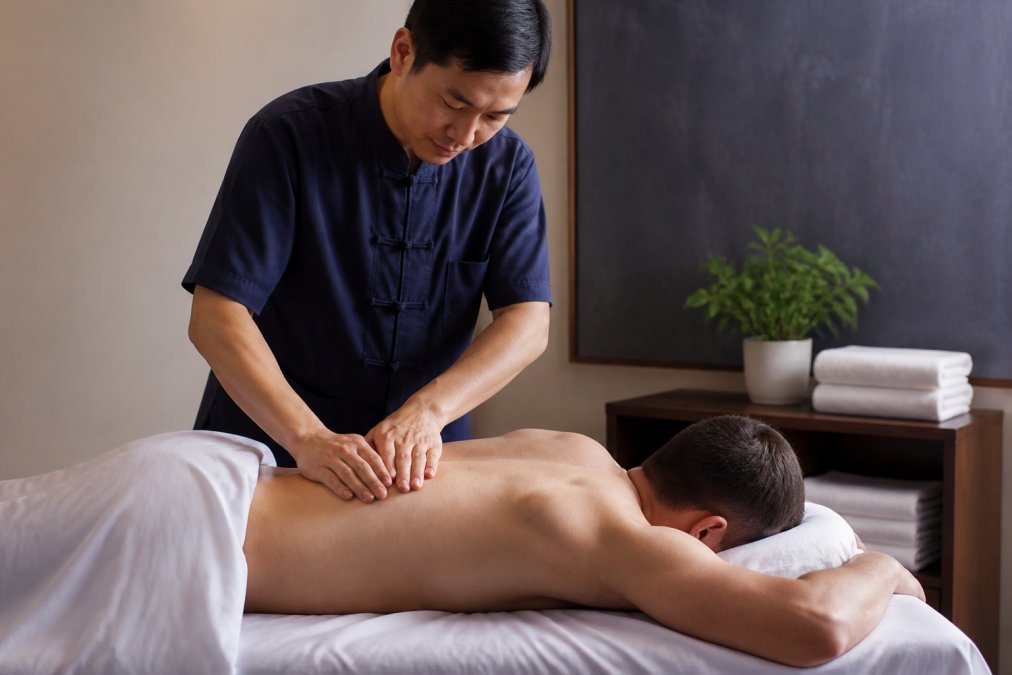
Tui Na for back pain aims to release muscle adhesions, reduce stiffness and improve range of motion in the lumbosacral area. Most patients describe firm but controlled pressure rather than sharp pain.
In traditional Chinese Medicine terms, back pain is often linked to qi stagnation: energy and blood not moving freely through the channels around the spine. Whatever your view of that framework, the physical effects are observable. Sustained pressure encourages tight tissue to lengthen, and joint mobilisation restores movement to stiffened segments. Over a course of sessions, patients commonly report less pain on waking, easier bending and less of that deep, heavy ache after sitting for long periods.
The first session rarely fixes anything. Soft tissue takes time to change, and a single treatment is a starting point, not a cure.
How Tui Na Is Adapted to Different Back Pain Patterns
Back pain is not one condition, and a practitioner adjusts technique, pressure and session length to the pattern you present with. The three most common patterns seen in clinic are lumbar strain, sciatica and chronic stiffness.
Lumbar strain usually follows a specific incident: lifting awkwardly, a sudden twist, or a long drive in an unfamiliar seat. The tissue is acutely inflamed and guarding.
Key Techniques Used in Treatment
Two techniques come up repeatedly in Tui Na training: Gun Fa and An Fa.
- Gun Fa (rolling): a rolling motion of the forearm or hand along the back muscles, used to warm and loosen larger areas of tissue
- An Fa (pressing): sustained pressure applied to specific acupressure points along the meridian channels
- Soft tissue manipulation: kneading and grasping movements that target muscle adhesions
- Joint mobilisation: gentle, controlled movement of the spinal joints to restore range of motion
What the Evidence Suggests
Tui Na sits within a wider body of research on manual therapy for low back pain. Systematic reviews of massage for low back pain generally find short-term improvements in pain and function compared with inactive controls, though evidence quality is often limited by small sample sizes and difficulty blinding participants. Tui Na specifically has been studied in several small trials suggesting it may reduce pain intensity and improve function in chronic low back pain, but larger, better-designed trials are still needed.
Tui Na vs Physiotherapy and Deep Tissue Massage
Tui Na differs from physiotherapy in working along meridian channels and acupressure points rather than focusing purely on exercise prescription and joint mechanics. This is not a claim that one is better; they approach the same problem from different directions.
| Approach | Main Focus | Typical Session Feel | Best Suited To |
|---|---|---|---|
| Tui Na | Meridian channels, acupressure points | Firm, rhythmic, targeted | Chronic stiffness, tension-based pain |
| Physiotherapy | Movement patterns, strength, rehab | Exercise-led, progressive | Post-injury recovery, weakness |
| Deep tissue massage | Specific tight muscle groups | Sustained, often intense | Localised knots and tightness |
Tui Na for Sports Recovery
Athletes often come to Tui Na for sports recovery because it targets the deep tissue that takes the strain during training. Recurring shoulder, hamstring and lower back complaints are the most common reasons people book.
What to Expect in a Session and Safety Considerations
A first session usually starts with questions rather than hands. Your practitioner will ask about the history of your back pain, your general health, any medication you take and whether you have had imaging or a diagnosis. (Source: guidance on complementary and alternative medicine)
Is Tui Na Right for Your Back Pain? A Self-Assessment Guide
Before booking, it helps to know whether your back pain is likely to respond to Tui Na or whether you should see a doctor first. These questions are not a diagnosis, but they can help you decide.
Tui Na may be suitable if:
- Your pain is in your back and does not travel below your knee
- It feels muscular: a deep ache, tightness or stiffness rather than a sharp, electric shock
- It is worse after sitting, driving or standing still, and eases with movement
- You have had it for more than a few days but less than three months, or it is a long-standing pattern you recognise
- You have no numbness, tingling or weakness in your legs
- You have not had a recent fall, accident or injury
See your GP or a physiotherapist first if:
- Your pain travels down your leg, especially below the knee
- You have numbness, tingling, pins and needles or weakness in your leg or foot
- You have difficulty passing urine, or numbness around the groin or saddle area
- Your pain started after a fall, a road accident or a sports injury
- You have unexplained weight loss, a history of cancer, or you feel unwell alongside the back pain
- Your pain is worse at night or when resting
- You are over 50 and this is a new type of back pain
After Your Session: Recovery and Maintenance
What you do in the 48 hours after a session has a real effect on how much you get from the treatment.
For the first 24 to 48 hours:
- Expect some tenderness in the treated area. This is normal and usually settles within a day or two.
- Drink water. There is no strong evidence that massage releases toxins that need flushing, but staying hydrated is sensible and many patients find it helps them feel better.
- Avoid heavy lifting, prolonged sitting and intense exercise on the day of treatment. A gentle walk is fine and often helpful.
- Apply warmth, not ice, if the area feels tight. A warm shower or a heat pack for 15 to 20 minutes can ease residual stiffness.
- Do not book a session immediately before an important event, competition or long drive.
For the weeks between sessions:
When to stop and seek advice:
Safety and Contraindications
Tui Na is generally low risk when performed by a trained practitioner, but it is not suitable for everyone. Tell your practitioner if you:
- Are pregnant, or think you may be
- Have osteoporosis, a spinal fracture or a diagnosed disc condition
- Have a bleeding disorder or take blood-thinning medication
- Have cancer, an active infection or a skin condition over the treatment area
- Have recently had surgery
Tui Na Diploma Course: Learning These Techniques
For practitioners and students, Tui Na is a trainable skill, and we teach these techniques through an accredited diploma course covering the theory behind traditional Chinese Medicine, the meridian system, point location, and the practical application of Gun Fa, An Fa and joint mobilisation.
Frequently Asked Questions
Is Tui Na massage effective for chronic lower back pain?
Research, including systematic reviews, suggests Tui Na can help reduce pain and improve function for some people with chronic low back pain. It works on soft tissue, muscle adhesions and blood circulation. Results vary by individual, and Tui Na is best used as part of a broader approach that may include other therapies. A qualified practitioner can assess whether it suits your specific condition.
What is the difference between Tui Na and regular massage?
Tui Na is a form of Traditional Chinese Medicine manual therapy, not a relaxation massage. It uses acupressure points, meridian channels and specific techniques like Gun Fa and An Fa to address musculoskeletal issues. Regular massage often focuses on general tension relief, while Tui Na targets specific conditions such as back pain, joint stiffness and sports injuries with a more clinical approach.
Can I learn Tui Na techniques to help others with back pain?
Yes. We teach these techniques through an accredited diploma course designed for practitioners who want to offer Tui Na professionally. The course covers core techniques, safety and clinical application for conditions like back pain. It suits those with a background in manual therapy or a strong interest in Traditional Chinese Medicine. Contact us to discuss entry requirements.
Is Tui Na massage painful?
Tui Na can involve deep tissue work and acupressure, so you may feel pressure or mild discomfort during treatment. Most people find it tolerable and report relief afterwards. A skilled practitioner adjusts pressure to your comfort and condition. Communicate openly during the session so the therapist can modify techniques. Some temporary soreness after treatment is normal and usually settles within a day or two.