 ultimate-guide
Benefits of Gua Sha Facial: A 2026 Guide
Table of Contents
- What Gua Sha Facial Is and Where It Comes From
- The Hollywood Trend and the Natural Skin Reset
- How to Use Gua Sha on Face: A Step-by-Step Routine
- Gua Sha for Facial Puffiness and Lymphatic Drainage
- How Often to Use Gua Sha for Best Results
- Gua Sha Before and After: What to Realistically Expect
- Safety, Hygiene and When to Stop
- Frequently Asked Questions
Last Updated: October 6, 2026
What Gua Sha Facial Is and Where It Comes From
A gua sha facial is a traditional Chinese medicine technique in which a smooth, polished stone is drawn across oiled skin in firm, deliberate strokes to move fluid, release muscular tension and stimulate circulation. In Mandarin, gua means to scrape and sha refers to the reddish marking that traditional practitioners read as a sign of movement. On the face, the pressure is far lighter than on the back or limbs, and the work is closer to structured facial massage than to scraping.
The practice sits inside a much older system. Traditional Chinese medicine treats the face as a map of channels connected to the rest of the body, and practitioners have used stone tools on the face and neck for centuries as part of wider treatment. At Lee Chinese Style Therapy Ltd, we teach facial gua sha as one component of a broader approach rather than a standalone fix.
The tool itself is usually a flat stone with a notched edge. Jade, rose quartz and green aventurine are common because they hold a cool temperature well and glide over facial oil without dragging. Shape matters more than colour: a heart-shaped or comb-edged stone reaches the jawline, cheekbones and brow bone more comfortably than a plain rectangle.
The Hollywood Trend and the Natural Skin Reset
Facial gua sha moved from clinic to camera when celebrities began posting their evening routines, and the tool became a fixture of red-carpet preparation. The appeal on screen is obvious: a few minutes of massage, a visible lift, a glow that reads well under lighting.
What the trend rarely explains is why the skin looks better afterwards. Two things are happening. First, fluid that has pooled in the tissue is moved along, so puffiness settles and contours look sharper. Second, the mechanical action of the strokes encourages blood flow to the surface, which is why the complexion looks warmer and brighter straight away.
The "reset" is the part worth understanding. Skin is not a static surface; it renews itself continuously, and the rate at which it does so depends on circulation, hydration and how well the tissue is draining. Regular, gentle gua sha supports those conditions. Over weeks rather than minutes, that shows up as skin that looks calmer and recovers faster from late nights, travel and stress. It builds back stronger because the conditions for repair have improved, not because the stone itself does anything magical.
That is a more modest claim than the internet makes, and a more useful one.
How to Use Gua Sha on Face: A Step-by-Step Routine
Start with a clean face and a slippery surface. Gua sha should never drag the skin; if the stone is tugging, you need more oil. A plain facial oil or a rich moisturiser both work. Hold the stone at roughly 30 to 45 degrees to the skin, almost flat, not upright, so the edge glides rather than digs in. Try positioning the Gua Sha stone towards the sweeping motion as though it would be angled into the skin as you push along the surface.
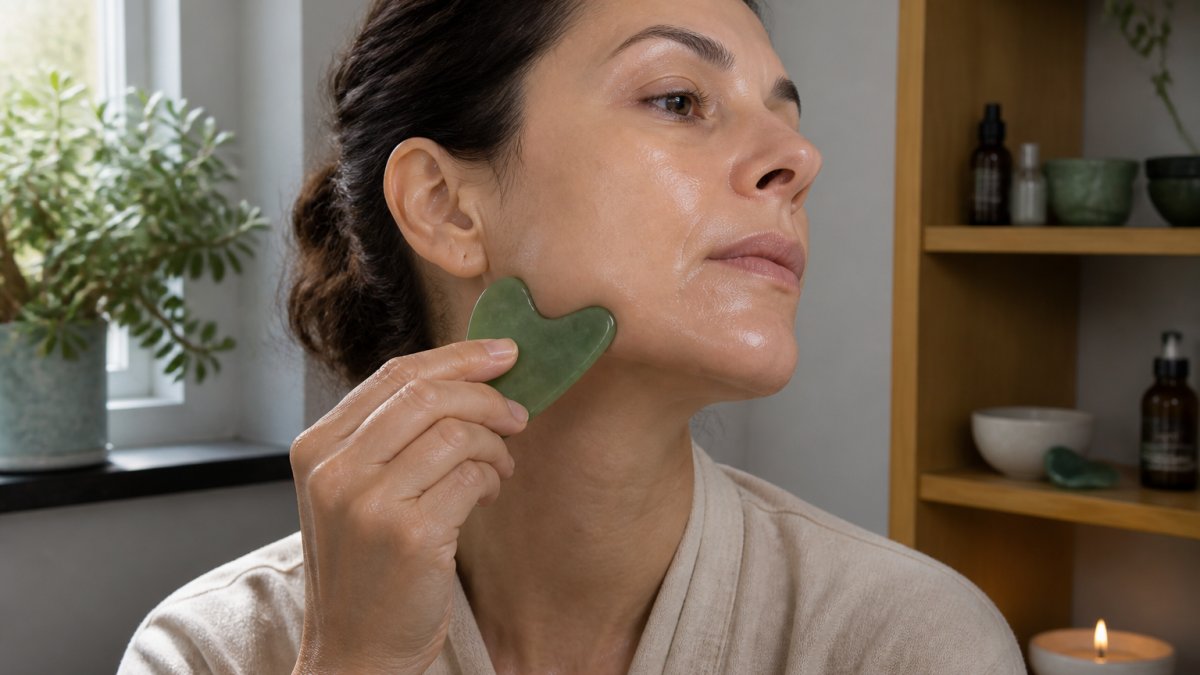
Work through the following sequence, keeping pressure light and strokes slow. Aim for the weight of a finger resting on a table, roughly the pressure you would use to spread eye cream, not to massage a shoulder. Each stroke should take about two seconds, and you should feel a gentle sensation.
- Neck first (60 seconds). Hold the stone almost flat and stroke downwards from behind the ear to the collarbone, five to seven times per side. This clears the pathway before you work the face.
- Jawline (45 seconds). With the notched edge, sweep from the chin outwards to the earlobe, five to seven strokes per side.
- Cheekbones (45 seconds). Sweep from the side of the nose outwards and slightly upwards towards the top of the ear, five strokes per side.
- Under the eye (30 seconds). Use the finest edge and feather-light pressure, moving from the inner corner outwards. Three to five strokes per side. This area is delicate; less is more.
- Brow and forehead (45 seconds). Stroke from the centre of the brow outwards to the temple, then upwards from the brow to the hairline, five strokes per direction.
- Finish the neck (30 seconds). Repeat the downward neck strokes to close the routine.
The whole sequence takes three to five minutes. If you are working with a practitioner, gua sha is often combined with Tui Na massage or acupressure to address the muscular tension underneath.
Gua Sha for Facial Puffiness and Lymphatic Drainage
Puffiness in the face is usually fluid sitting in the tissue, and it collects overnight because you have been horizontal for hours. The lymphatic system has no pump of its own; it relies on movement, muscle contraction and gravity to shift fluid back towards the neck and into circulation. That is why the neck strokes come first in any routine.
Used consistently, gua sha for facial puffiness works on the same principle. The strokes follow the direction the fluid needs to travel, and the mechanical action encourages the vessels to move it along. Most people notice a difference in the mirror immediately after a session, particularly around the eyes and along the jaw.
The effect is temporary, and it is worth being honest about that. A single session will not change the underlying structure of your face. What it does is reduce the daily accumulation that makes features look heavier than they are. For anyone dealing with puffiness that does not settle, or with swelling on one side only, that needs a medical opinion rather than a massage tool.
How Often to Use Gua Sha for Best Results
Daily use is fine for most people at light pressure, and many practitioners suggest five to seven short sessions a week rather than one long one. Consistency matters more than duration. A three-minute routine done most evenings will do more than a twenty-minute session once a fortnight.
Frequency | Session Length | Best For |
|---|---|---|
Daily | 3-5 minutes | Maintaining drainage, morning puffiness |
Every other day | 5-8 minutes | Sensitive or reactive skin |
Weekly | 10-15 minutes | Combining with a fuller facial routine |
Before events | 5 minutes | Short-term de-puffing and glow |
If your skin is prone to redness or you are using active ingredients such as retinoids, start at every other day and build up. Stop if the skin becomes sore, and give it a few days before resuming at lighter pressure.
Gua Sha Before and After: What to Realistically Expect
The honest answer is that gua sha before and after results differ by timescale, and the gap between what the internet promises and what the evidence supports is wide. It helps to separate three categories of claim.
Well-supported short-term effects. Immediately after a session, expect reduced puffiness, a warmer and brighter complexion, and a jawline that looks more defined. These are the effects most consistent with the known mechanics of facial massage: fluid is moved along the lymphatic pathways, and blood flow to the surface increases.
Plausible but modest medium-term effects. Over four to six weeks of regular practice, people commonly report that their skin looks calmer and that morning puffiness is less pronounced. This is where the natural reset becomes relevant. Skin renews itself continuously, and the rate at which it does so depends on circulation, hydration and how well the tissue is draining.
Claims the evidence does not support. Gua sha will not remove lines, change the shape of your face, boost collagen production in any meaningful way, or replace in-clinic treatment for a specific concern. Anyone promising otherwise is overselling.
If you want to track your own results honestly, take a photo in the same spot, at the same time of day, under the same lighting, before your first session and then once a week. Morning light near a window is more consistent than bathroom lighting.
Safety, Hygiene and When to Stop
Clean your tool after every use with warm water and mild soap, then dry it fully before storing. Stone left damp in a bathroom cabinet can develop a film that transfers to your skin. Never share a tool with someone who has an active skin infection.
Skip gua sha entirely if you have a bleeding disorder, are taking blood-thinning medication, or have a condition affecting the skin's fragility. Avoid the area over recent fillers or botulinum injections for the period your practitioner advises, and do not use it over any undiagnosed lump or swelling.
Stop immediately if you notice persistent redness, bruising that does not fade within a few days, or pain rather than comfortable pressure. None of those are normal responses to a correctly performed routine, and they are a signal to seek advice rather than push through.
If you are unsure whether gua sha is appropriate for your skin, a consultation with a qualified practitioner is the sensible first step. Our team at Lee Chinese Style Therapy Ltd offers gua sha and cosmetic facial acupuncture as part of a wider assessment, so the technique is matched to your skin rather than applied generically.
Frequently Asked Questions
Does facial gua sha really work?
Facial gua sha can produce visible short-term effects like reduced puffiness and a brighter complexion by supporting circulation and lymphatic drainage. Research on gua sha is still growing, and results vary. It works best as part of a consistent skincare routine rather than a one-off treatment. For lasting changes in skin tone or contour, regular practice over weeks matters more than a single session. expect to see lasting results in 6-12 sessions.
How often should you do gua sha facial?
Most people can use gua sha on the face three to five times per week. If your skin is sensitive, start with two sessions per week and build up. Daily use is generally fine for healthy skin, but stop if you notice redness, tenderness or irritation. The key is gentle pressure and listening to how your skin responds.
Can gua sha reduce facial puffiness?
Yes, gua sha for facial puffiness is one of its most reported benefits. The massage strokes encourage lymphatic drainage, which helps move excess fluid away from the face. You may notice a difference within minutes, especially around the eyes and jawline. Results are temporary, so regular practice is needed to maintain the effect.
Who should avoid facial gua sha?
Avoid gua sha if you have active acne, open wounds, sunburn, or a skin infection on your face. People with bleeding disorders, those taking blood-thinning medication, or anyone with a recent facial procedure should speak to a qualified professional first. If you are unsure, book a consultation with a traditional Chinese medicine practitioner who can assess your skin safely.
Facial puffiness, dullness and tension rarely have a single cause, and a tool alone will not resolve them. At Lee Chinese Style Therapy Ltd, we combine gua sha with acupuncture, Tui Na massage and cupping to address both the surface and the underlying pattern, working from a proper assessment rather than a template. If you want a routine built around your skin and your history, book a consultation and we will map out what will actually help.