 how-to
Acupuncture for Shoulder Injury Recovery: A 2026 Guide
Table of Contents
- How Acupuncture Works for Shoulder Injury Recovery
- Shoulder Conditions That Respond to Acupuncture
- What to Expect During Acupuncture for Shoulder Injury
- How Many Acupuncture Sessions for Shoulder Injury Recovery?
- Acupuncture and Tui Na for Shoulder Pain: A Combined Approach
- Integrating Acupuncture with Physical Therapy and Rehabilitation
- Contraindications, Red Flags, and When to Seek Medical Advice
- Conclusion: Your Next Steps for Shoulder Recovery
- Frequently Asked Questions
Last Updated: September 13, 2026
How Acupuncture Works for Shoulder Injury Recovery
Acupuncture for shoulder injury recovery works by combining local needle stimulation with a broader neurological response that influences pain signalling, circulation and tissue healing. At Lee Chinese Style Therapy Ltd, we approach shoulder injuries as a whole-system problem rather than an isolated joint issue, because the shoulder rarely fails on its own.
The treatment sits within a well-established tradition. The World Health Organization's acupuncture training benchmarks recognise acupuncture as a regulated therapeutic practice with defined clinical applications, and the National Institute for Health and Care Excellence guidance on chronic pain acknowledges acupuncture as an option for some persistent musculoskeletal pain presentations.
Two mechanisms matter most for shoulders: how needles affect blood flow and inflammation, and how they change the way the nervous system registers pain.
Blood Flow Stimulation and the Anti-Inflammatory Response
Fine needles placed into the soft tissue around the shoulder create a controlled micro-stimulus. The body responds with local vasodilation, bringing blood, oxygen and repair cells to an area that is often poorly perfused after injury.
This is the part most people miss: a shoulder that has been guarded and immobile for weeks does not just have a torn or inflamed structure, it has a circulation problem. Restoring blood flow stimulation to the rotator cuff and surrounding musculature is a prerequisite for tissue repair.
In practice, this means treatment is often directed at the tissue around the injury, not only at the point of pain.
Pain Modulation and the Pain Threshold
Acupuncture raises the pain threshold by influencing how the nervous system transmits and interprets nociceptive signals. Needling stimulates nerve fibres that feed into the spinal cord and brainstem, which can dampen the pain response and reduce the protective muscle guarding that limits range of motion.
For chronic shoulder pain, this matters more than the local tissue effect. Many long-standing shoulder problems persist because the nervous system has become sensitised, not because the original injury is still active.
Shoulder Conditions That Respond to Acupuncture
Acupuncture is most useful for soft-tissue and inflammatory shoulder conditions, particularly those where pain and guarding are limiting movement. It is not a substitute for surgical assessment where a structural tear or fracture is present.
Common presentations we see include rotator cuff tendinopathy, shoulder impingement syndrome, frozen shoulder, postural neck-and-shoulder tension, and post-injury muscle damage in athletes.
Rotator Cuff Tendinopathy and Shoulder Impingement Syndrome
Rotator cuff tendinopathy involves degenerative change and overload in the tendons that stabilise the shoulder. Shoulder impingement syndrome occurs when the tendons and bursa are compressed under the acromion during overhead movement.
Both conditions respond to a combination of reducing local inflammation, releasing surrounding myofascial tension, and restoring normal movement mechanics. Acupuncture addresses the first two; rehabilitation addresses the third.
| Condition | Primary Acupuncture Target | Typical Focus |
|---|---|---|
| Rotator cuff tendinopathy | Tendon and muscle attachment points | Inflammation reduction, tissue repair |
| Shoulder impingement syndrome | Subacromial soft tissue, upper back | Myofascial release, range of motion |
| Frozen shoulder | Capsule surrounding tissue, trigger points | Pain modulation, mobility |
| Post-injury muscle damage | Local musculature, adjacent segments | Blood flow stimulation, recovery |
What to Expect During Acupuncture for Shoulder Injury
A first session typically involves a consultation, a physical assessment of the shoulder and neck, and treatment lasting around 20 to 30 minutes with needles in place. Most people feel a mild ache or heaviness at the needle site rather than sharp pain.
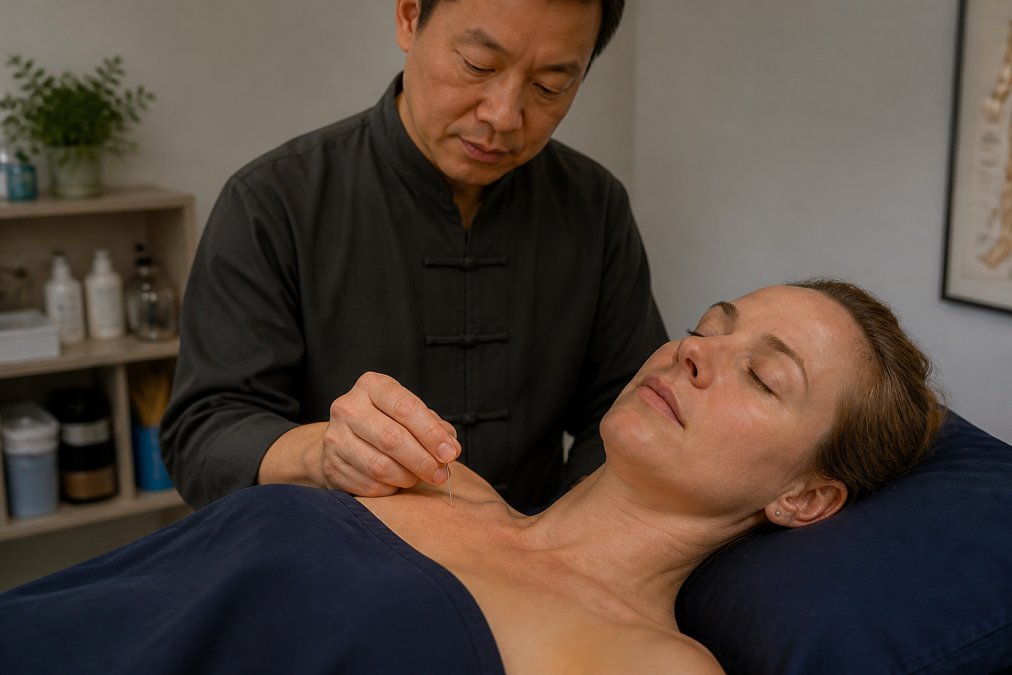
You will usually be treated lying down or seated, with the affected arm supported. Needles are sterile and single-use. Some people feel relaxed during treatment; others feel a temporary increase in soreness for a day afterwards, which generally settles.
Your practitioner should explain what they are doing and why, and should ask about your medical history, medications and any previous imaging before starting.
How Many Acupuncture Sessions for Shoulder Injury Recovery?
Most people need a course of treatment rather than a single session, with an initial block followed by a structured review. The honest answer to how many acupuncture sessions for shoulder injury you will need depends on whether the problem is acute or chronic, and on how your shoulder responds in the first two weeks.
A common pattern among practitioners is:
- Acute injuries (e.g. a recent strain or minor tear): 4 to 6 sessions over 2 to 3 weeks, with a review after session 3.
- Chronic shoulder pain (present for 3 months or more): 6 to 10 sessions over 4 to 6 weeks, with a review after session 4.
- Frozen shoulder or post-surgical recovery: a longer course, often 10 to 12 sessions, paced around your physiotherapy milestones.
Progress is measured by function, not just pain scores. A useful review point asks: can you reach overhead, sleep on that side, or carry a bag without guarding? If there is no meaningful change after a reasonable trial, typically 4 to 6 sessions, that is useful information. It means the diagnosis or the treatment plan needs revisiting, not that you should keep paying for more of the same.
What the Evidence Says About Session Frequency
The National Institute for Health and Care Excellence guidance on chronic pain acknowledges acupuncture as an option for some persistent musculoskeletal pain presentations, typically as part of a broader management plan. Most clinical guidelines suggest a trial of 4 to 6 sessions before judging whether acupuncture is helping. Beyond that, frequency should taper as range of motion and strength improve, for example, moving from weekly to fortnightly sessions once you can complete daily activities with less than 3/10 pain.
Recovery Timelines You Can Expect
- First 1 to 2 sessions: many people notice reduced pain guarding and easier movement for a day or two.
- Sessions 3 to 6: cumulative reduction in baseline pain, better sleep, and improved tolerance to rehabilitation exercises.
- Sessions 6 to 10: functional gains, reaching overhead, dressing, or driving with less discomfort, become the main marker of progress.
If you are not seeing these patterns, discuss with your practitioner whether acupuncture is the right fit or whether you need further assessment.
Acupuncture and Tui Na for Shoulder Pain: A Combined Approach
Combining acupuncture and Tui Na for shoulder pain often produces better results than either technique alone, because they address different layers of the problem. Acupuncture works on pain signalling and circulation; Tui Na works directly on muscle tone, adhesions and joint mobility.
Tui Na is a hands-on Chinese manual therapy that uses pressing, rolling, kneading and stretching techniques. Applied to the shoulder girdle, upper back and neck, it can release the myofascial tension that keeps pulling the joint out of alignment. Specific techniques include:
- Gun fa (rolling): used over the deltoid and upper trapezius to reduce tone without aggravating the joint.
- An fa (pressing): sustained pressure on trigger points in the rotator cuff and scapular stabilisers.
- Na fa (kneading): deeper work into the pectoralis minor and latissimus dorsi, which often contribute to forward shoulder posture.
- Ban fa (stretching): gentle traction and rotation to improve glenohumeral mobility.
The sequence matters. Releasing tissue before needling often makes treatment more comfortable and more effective, and it gives the practitioner a clearer picture of where the restriction actually sits. A typical session might spend 10 to 15 minutes on Tui Na, followed by 20 to 30 minutes of acupuncture with needles retained.
How Tui Na Compares with Acupuncture Alone
Acupuncture alone can reduce pain and guarding, but it does not directly lengthen shortened tissue or break down adhesions. Tui Na alone can improve mobility, but it may be uncomfortable if the shoulder is highly sensitised. Combining them allows the practitioner to reduce pain first, then work more deeply into the soft tissue, a sequence that most patients find more tolerable and more effective.
At Lee Chinese Style Therapy Ltd, we use Tui Na alongside acupuncture because shoulder injuries rarely involve one structure in isolation. The combination is particularly useful for frozen shoulder and post-injury muscle damage, where both pain modulation and tissue release are needed.
Integrating Acupuncture with Physical Therapy and Rehabilitation
Acupuncture works best as part of a rehabilitation protocol, not as a standalone fix. The needles reduce pain and guarding; the exercises rebuild strength, control and range of motion. Skip the second half and the problem tends to return.
Post-acupuncture rehabilitation exercises are where most people fall short. The window after treatment, when pain is reduced and tissue is more responsive, is the best time to work on movement quality.
A simple post-treatment routine:
- Pendulum swings to encourage gentle glenohumeral movement
- Scapular setting exercises to retrain shoulder blade control
- Banded external rotation for rotator cuff strength
- Wall slides for overhead range of motion
- Isometric holds at pain-free angles
Keep the effort low and the frequency regular. Little and often beats one aggressive session.
Contraindications, Red Flags, and When to Seek Medical Advice
Acupuncture is generally well tolerated, but it is not appropriate for everyone and it is not a reason to delay urgent medical assessment. Knowing the red flags matters more than knowing the benefits.
Seek medical advice before acupuncture if you have a bleeding disorder, are taking anticoagulant medication, have a pacemaker or implanted device, have a known infection at the treatment site, or are pregnant.
Stop and seek urgent assessment if you experience:
- Severe pain following a fall or direct impact
- Inability to lift the arm at all after injury
- Numbness, tingling or weakness in the hand or forearm
- Visible deformity of the shoulder
- Fever, redness or swelling around the joint
These signs suggest fracture, dislocation, nerve involvement or infection, none of which acupuncture treats. A qualified practitioner should refer you on rather than treat through them.
Conclusion: Your Next Steps for Shoulder Recovery
Shoulder injuries rarely resolve on their own once pain has become chronic, and waiting for it to settle is the most common mistake we see. The right approach combines pain modulation, hands-on soft-tissue work and a structured rehabilitation plan you actually follow.
If you are dealing with a shoulder that has not responded to rest or previous treatment, Lee Chinese Style Therapy Ltd offers acupuncture, Tui Na massage and cupping delivered by practitioners who treat the whole shoulder complex rather than the sore spot alone. Every course begins with an assessment and a review point, so you can judge progress honestly before committing further.
Get started with Lee Chinese Style Therapy Ltd and give your shoulder the structured recovery it has been missing.
Frequently Asked Questions
How long does it take for acupuncture to work for shoulder pain?
Some people notice a reduction in pain after their first few sessions, while others need a longer course. Response depends on whether the injury is acute or chronic, how severe it is, and how your body responds to treatment. A common pattern is a cumulative effect over several weeks. Your practitioner should review progress at intervals and adjust the plan if you are not seeing meaningful change.
Can acupuncture help with rotator cuff recovery?
Acupuncture is often used alongside other care for rotator cuff tendinopathy and similar soft-tissue problems. It may help reduce pain and improve range of motion, which can make rehabilitation exercises easier to perform. It is not a stand-alone cure for a full tear. If you have a suspected complete rupture, get a medical assessment first, then discuss whether acupuncture fits your rehabilitation protocol.
Is acupuncture a safe complementary therapy for musculoskeletal injuries?
When performed by a qualified practitioner, acupuncture is generally considered low risk. Common side effects include minor bruising or soreness at needle sites. Serious complications are rare. Tell your practitioner about any blood-thinning medication, bleeding disorders, implanted devices, or pregnancy. They should also know about any recent trauma, fever, or signs of infection near the shoulder before treatment begins.
What should I expect during an acupuncture session for shoulder pain?
A first appointment usually includes a detailed history, shoulder examination, and discussion of your goals. Fine needles are inserted at selected acupuncture points, often locally around the shoulder and sometimes at distant points. You may feel a dull ache or tingling. Needles typically stay in for 20 to 30 minutes. Some practitioners add Tui Na massage, cupping, or advice on exercises to do at home.