 ultimate-guide
Does Acupuncture Help Menopause Symptoms? A Beginner's Guide
Table of Contents
- What Is Acupuncture and How Does It Fit Into Menopause Care?
- Does Acupuncture Help Menopause Symptoms? What the Evidence Says
- Acupuncture for Hot Flushes and Night Sweats
- Acupuncture Treatment Frequency for Menopause: How Many Sessions?
- Natural Menopause Symptom Relief: Where Acupuncture Fits
- What to Expect During a Session, Safety and Side Effects
- Frequently Asked Questions
Last Updated: September 18, 2026
What Is Acupuncture and How Does It Fit Into Menopause Care?
Acupuncture is a traditional Chinese medicine practice in which fine, sterile needles are inserted into specific points on the body to influence the flow of qi, or vital energy, along pathways called meridians. For menopause, it is used as a non-pharmacological option to help manage hot flushes, night sweats, sleep disturbances and mood swings. This guide from Lee Chinese Style Therapy Ltd explains what the evidence shows and answers the question: does acupuncture help menopause symptoms?
Many women reach a point where their GP has offered hormone therapy, or they cannot take it, and they are left wondering what else exists. Acupuncture sits within that gap. It is not a replacement for medical care, and it is not a cure. It is a supportive therapy that many women use alongside conventional treatment to take the edge off vasomotor symptoms and improve day-to-day well-being.
Jade, our menopause expert at Lee Chinese Style Therapy Ltd, puts it plainly: "Women often arrive exhausted, having tried several routes already. What acupuncture offers is regular, structured support for symptom management while their body moves through the menopause transition."
The Traditional Chinese Medicine View of Menopause
In traditional Chinese medicine, menopause is not treated as a deficiency to be corrected. It is understood as a natural shift in the body's balance, where kidney yin and yang, the energies governing cooling, warming and hormonal regulation, gradually decline. Symptoms such as hot flushes and night sweats are read as signs of that imbalance rather than a disease in themselves.
That framing matters for beginners, because it explains why treatment is personalised. Two women with identical symptoms may receive needles in different acupuncture points, depending on whether their pattern leans hot, dry, agitated or depleted.
Does Acupuncture Help Menopause Symptoms? What the Evidence Says
The honest answer is that the evidence is mixed but encouraging, particularly for hot flushes and night sweats. The most-cited summary is the Cochrane review of acupuncture for menopausal vasomotor symptoms, which found that acupuncture may reduce hot flush frequency and severity compared with no treatment, but that it performs similarly to sham acupuncture in many trials. That last point matters: it suggests part of the benefit may come from the therapeutic encounter itself, which is true of many holistic therapies.
In the UK, the National Institute for Health and Care Excellence (NICE) does not recommend acupuncture as a first-line treatment for menopausal symptoms. NICE guidance on menopause places hormone replacement therapy (HRT) and cognitive behavioural therapy (CBT) as the main evidence-based options for vasomotor symptoms, with acupuncture listed as a complementary approach that some women choose. That is not a rejection, it is a positioning. Acupuncture sits alongside, not instead of, what your GP can offer.
What the research does not support is the claim that acupuncture will eliminate menopause symptoms entirely. It is best understood as one evidence-based tool within a broader treatment plan, not a standalone solution.
Jade's View: What We See in Clinic
"What most guides miss is the pattern, not the single session," Jade says. "Women who attend consistently, usually weekly at first, report better sleep and fewer night sweats within the first few weeks. Those who come once and stop rarely notice a lasting change. And the women who do best are the ones who tell their GP what they are doing, so nothing gets missed."
That observation matches the clinical literature on treatment frequency, which we cover below. It also points to the biggest gap in most online guides: nobody explains how to slot acupuncture into the care you are already receiving. We cover that in the next section.
Acupuncture for Hot Flushes and Night Sweats
Acupuncture for hot flushes works by targeting points linked to temperature regulation and the autonomic nervous system, with the aim of reducing both the frequency and intensity of flushes. Many women describe flushes easing from overwhelming to manageable rather than disappearing altogether.
Night sweats respond in a similar way, and because they disrupt sleep, improvements here often produce the biggest reported change in overall well-being. Better sleep reduces fatigue, which in turn reduces anxiety and mood swings. It is a cascade effect, and it is why sleep is often the first thing we ask about.
Acupuncture Treatment Frequency for Menopause: How Many Sessions?
Acupuncture treatment frequency for menopause typically starts at one session per week for four to six weeks, then reduces to fortnightly or monthly maintenance as symptoms settle. There is no single correct number, and anyone promising a fixed figure before assessing you is guessing.
A sensible structure looks like this:
| Stage | Typical Frequency | Purpose |
|---|---|---|
| Weeks 1-4 | Once weekly | Establish response, adjust points |
| Weeks 5-8 | Once weekly or fortnightly | Build on early gains |
| Month 3 onward | Monthly or as needed | Maintain symptom management |
If you notice no change at all after six sessions, that is useful information.
Natural Menopause Symptom Relief: Where Acupuncture Fits
Natural menopause symptom relief rarely comes from one intervention alone, and acupuncture is most effective as part of a wider plan. The women who do best tend to combine several approaches rather than relying on any single therapy.
- Acupuncture for hot flushes, night sweats and sleep disturbances
- Acupressure, which you can apply yourself between sessions at points such as LI4 in the hand and SP6 above the ankle
- Diet and hydration, particularly reducing caffeine, alcohol and spicy food, all common flush triggers
- Movement, since regular gentle exercise supports mood and sleep quality
- Medical review, because hormone therapy and other options remain valid and can be used alongside acupuncture
What to Expect During a Session, Safety and Side Effects
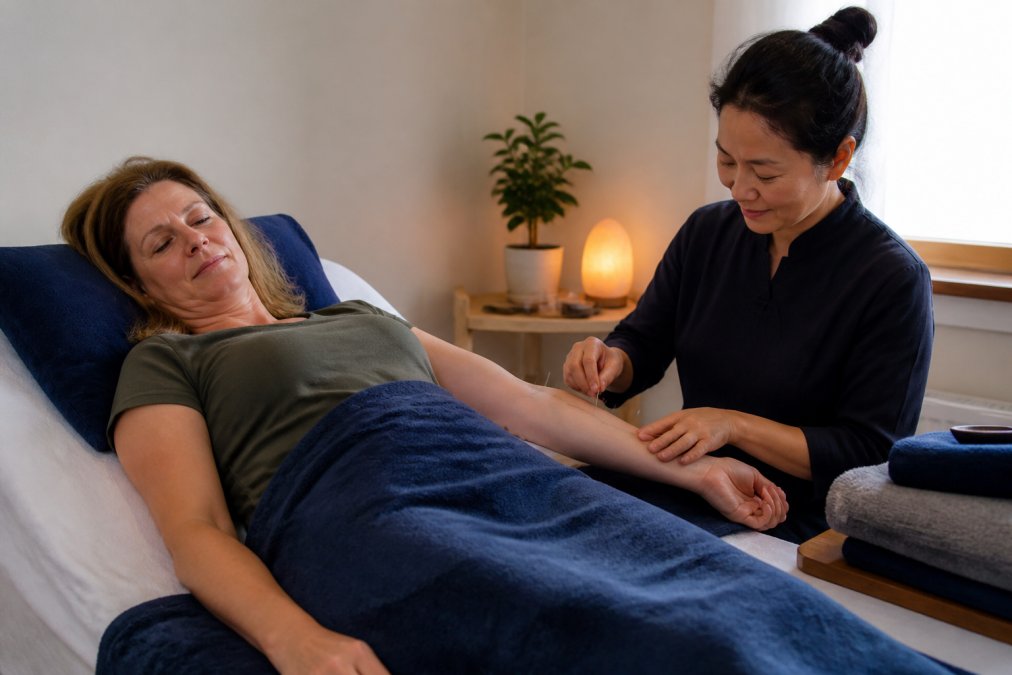
A first session usually runs 45 to 60 minutes and includes a detailed history, tongue and pulse assessment, then needle placement for 20 to 30 minutes while you rest. Most people feel a mild dull ache or tingling at the needle site, not sharp pain. Many fall asleep.
How to Check a Practitioner Is Properly Regulated
In the UK, acupuncture is not a protected title, which means anyone can call themselves an acupuncturist. That is why checking credentials matters more here than in many other therapies. Look for a practitioner who is a member of a recognised professional body, such as the British Acupuncture Council (BAcC) or the Acupuncture Society, and who holds current professional indemnity insurance.
A simple checklist before you book:
- Ask which professional body they belong to and verify it on that body's website.
- Confirm they use sterile, single-use disposable needles.
- Ask whether they will write to your GP with your consent, so your medical records stay joined up.
- Check they hold current insurance and are happy to show evidence of it.
How to Talk to Your GP About Acupuncture
Most guides treat acupuncture as an alternative to conventional care. We think that is the wrong framing. The women who get the most from treatment are the ones who tell their GP what they are doing and why.
A practical way to start the conversation:
- Book a routine appointment rather than raising it at the end of another consultation.
- Say plainly: "I am considering acupuncture for my hot flushes and night sweats alongside what you have recommended. Is there any reason it would not be suitable for me?"
- Mention any medication you take, especially blood thinners, and any condition that affects bleeding or immunity.
- Ask whether your GP is happy to be contacted by the practitioner, and whether they would like a short summary of your treatment.
- Keep a simple symptom diary so you can show your GP whether it is helping.
Frequently Asked Questions
Can acupuncture help with hot flushes and night sweats?
Research into acupuncture for hot flushes is mixed but encouraging. Some trials report fewer and less intense hot flushes and night sweats during treatment, particularly in the first few months. Others show smaller differences when compared with a placebo. Acupuncture is not a guaranteed fix, and results vary between women. Many find it a useful addition alongside other approaches, so it is worth discussing with a qualified practitioner who can assess your symptoms and explain what is realistic for you.
How many acupuncture sessions are typically needed for menopause relief?
There is no single answer, because acupuncture treatment frequency for menopause depends on your symptoms, their severity and how you respond. A common approach starts with weekly sessions for several weeks, then spaces them out as things improve. Some women notice changes after three or four sessions; others need longer. Your practitioner should review progress with you regularly rather than committing you to a fixed block of appointments upfront.
Is acupuncture a safe complementary therapy for menopause?
When performed by a trained, insured practitioner, acupuncture is generally considered low risk. Common side effects are minor, such as small bruises or brief soreness where needles are placed. Serious complications are rare. If you are pregnant, taking blood-thinning medication, or have a bleeding disorder or implanted medical device, tell your practitioner first. Acupuncture can sit alongside conventional care, but it should not replace advice from your GP about hormone therapy or other prescribed treatment.
How long does it take for acupuncture to affect hormone-related symptoms?
Some women report changes within the first few sessions, while others need several weeks of regular treatment before noticing a difference. Responses vary widely, and research does not support a fixed timeline. Keeping a simple symptom diary, noting hot flushes, sleep and mood, can help you and your practitioner judge whether acupuncture is helping. If you see no change after a reasonable trial, it is sensible to review the treatment plan rather than continue indefinitely.