 comparison
Cosmetic Acupuncture vs Botox Results: Full Comparison
Table of Contents
- At a Glance: Cosmetic Acupuncture vs Botox Results Compared
- How Each Treatment Works: Muscle Paralysis vs Collagen Stimulation
- The Benefits of Cosmetic Facial Acupuncture Beyond Wrinkle Reduction
- How Long Does Cosmetic Acupuncture Last Compared With Botox?
- Non-Surgical Facial Rejuvenation: Which Option Fits Your Goals?
- Safety, Side Effects and Who Should Avoid Each Treatment
- Combining Treatments and Maintaining Long-Term Skin Health
- Frequently Asked Questions
Last Updated: September 27, 2026
At a Glance: Cosmetic Acupuncture vs Botox Results Compared
Cosmetic acupuncture vs botox results is the comparison most people searching for facial rejuvenation eventually land on, and the honest answer is that the two treatments are doing fundamentally different jobs. Botox relaxes the muscles that crease your skin; cosmetic acupuncture works on the skin itself, encouraging collagen synthesis and better circulation over a series of sessions. At Lee Chinese Style Therapy Ltd, we see clients arrive expecting one to replace the other, when in practice they suit different wrinkles, different timelines and different temperaments. (Source: Botulinum toxin type A products: updated warnings regarding risk of iatrogenic botulism)
| Factor | Botox | Cosmetic Acupuncture |
|---|---|---|
| Mechanism | Muscle paralysis via neuromodulator | Micro-trauma triggering collagen synthesis |
| Best for | Dynamic wrinkles | Fine lines, skin texture, tone |
| First results | Within days | After several sessions |
| Longevity | Three to four months | Cumulative, with maintenance |
| Feel | Injectable, clinical | Needle-based, relaxing |
How Each Treatment Works: Muscle Paralysis vs Collagen Stimulation
The core difference comes down to what each treatment is actually targeting: the muscle beneath the skin, or the skin and its supporting layers. Understanding that distinction explains almost every other difference in results.
Botox: Neuromodulator Action on Dynamic Wrinkles
Botox is a prescription-only injectable neuromodulator. It works by temporarily reducing the muscle contractions that fold the skin into dynamic wrinkles, the lines that appear when you frown, squint or raise your eyebrows. Because the muscle can no longer contract fully, the overlying skin smooths out. The effect is targeted, predictable and reasonably quick, which is why it dominates the injectable market.
Cosmetic Acupuncture: Micro-Trauma and Collagen Synthesis
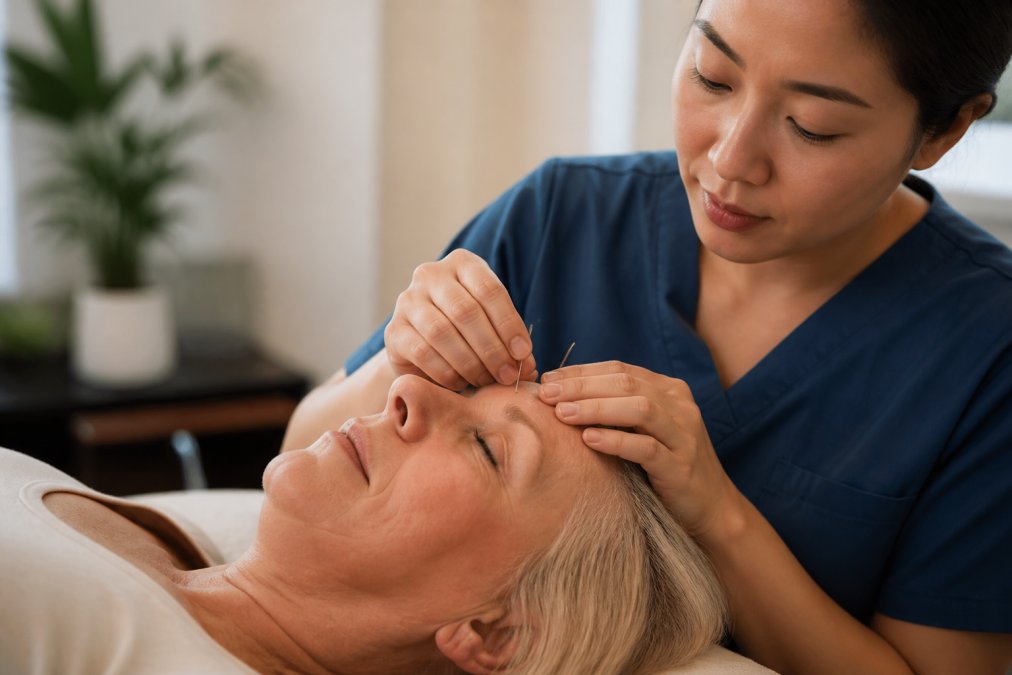
Cosmetic facial acupuncture takes the opposite route. Fine needles are placed into the dermal layer, creating controlled micro-trauma that prompts the body's own repair response. That response includes collagen synthesis, improved local circulation and better skin elasticity over time. Rather than paralysing anything, it stimulates. The treatment is non-invasive, toxin-free and works with your facial tissue rather than against it.
The Benefits of Cosmetic Facial Acupuncture Beyond Wrinkle Reduction
The benefits of cosmetic facial acupuncture extend well past softening fine lines. Because the needles also target traditional acupuncture points, clients often report better sleep, less facial tension and a general sense of calm alongside the visible skin changes.
How Long Does Cosmetic Acupuncture Last Compared With Botox?
How long does cosmetic acupuncture last? Results are cumulative rather than fixed, typically building across a course of sessions and then maintained with periodic top-ups. Botox, by contrast, wears off on a predictable clock, generally within three to four months, at which point the muscle resumes full contraction and the lines return.
Non-Surgical Facial Rejuvenation: Which Option Fits Your Goals?
Non-surgical facial rejuvenation covers a wide spectrum, and the right choice depends less on which treatment is stronger and more on which wrinkles you actually have. This is where most people get it wrong.
Dynamic vs Static Wrinkles: Choosing the Right Target
Dynamic wrinkles are caused by muscle movement and appear when you make an expression. Static wrinkles are visible at rest and reflect changes in the skin itself, including lost collagen and elasticity.
- Dynamic wrinkles (crow's feet, frown lines): Botox is the more direct tool.
- Static wrinkles and poor texture: cosmetic acupuncture addresses the underlying skin quality.
- Sagging, dull tone, puffiness: acupuncture and lymphatic work target these better.
- A mix of both: combination therapy, which we cover below.
Safety, Side Effects and Who Should Avoid Each Treatment
Both treatments have a safety profile that depends heavily on who is administering them and your own medical history. Neither is risk-free, and anyone promising otherwise should be treated with caution. The more useful question is not which is safer in the abstract, but which is safer for you specifically.
Botox: Prescription-Only Status and Contraindications
Botox is a prescription-only medicine in the UK. It must be prescribed and administered by a qualified healthcare professional, and you should be cautious of any provider who offers it without a face-to-face consultation. Common side effects include temporary bruising, mild headache and tenderness at the injection sites. Less commonly, the neuromodulator can spread beyond the target muscle, causing eyelid drooping, an uneven smile or a temporarily heavy brow. These effects are usually transient but can be distressing.
- Are pregnant or breastfeeding
- Have a neuromuscular disorder such as myasthenia gravis or Lambert-Eaton syndrome
- Have an active infection or skin condition at the injection site
- Are taking certain antibiotics or muscle relaxants that interact with the neuromodulator
- Have a known allergy to any component of the formulation (Source: the benefits of cosmetic facial acupuncture extend beyond wrinkle reduction)
Cosmetic Acupuncture: Lower Risk, But Not Zero
Cosmetic acupuncture carries a much lower risk profile than injectables. The usual complaints are minor bruising or tenderness at needle sites, and occasionally a small drop of blood when a needle is removed. Serious adverse events are rare when the treatment is delivered by a qualified practitioner using sterile single-use needles.
- Take anticoagulants such as warfarin, apixaban or rivaroxaban
- Have a bleeding disorder such as haemophilia or thrombocytopenia
- Have an autoimmune condition, particularly one affecting the skin or connective tissue
- Have a skin infection, cold sore or open wound in the treatment area
- Have a history of fainting or needle phobia
- Are pregnant, as certain acupuncture points are avoided
- Have a pacemaker or other implanted electrical device, as some practitioners use microcurrent alongside needles
Comparing the Risk Profiles
| Risk Factor | Botox | Cosmetic Acupuncture |
|---|---|---|
| Bruising | Common | Common but usually milder |
| Headache | Possible | Rare |
| Muscle weakness or drooping | Possible if product spreads | Not applicable |
| Infection | Rare with proper technique | Rare with sterile needles |
| Systemic interaction | Possible with certain medicines | Minimal |
| Suitability in pregnancy | Not recommended | Avoid, certain points contraindicated |
The key takeaway is that cosmetic acupuncture is the lower-risk option for most people, but it is not risk-free, and it is not suitable for everyone. Botox is more predictable in its effects but carries a higher burden of contraindications and requires a prescriber. Neither should be chosen on safety grounds alone without a proper assessment.
Combining Treatments and Maintaining Long-Term Skin Health
The most useful insight is that this is not an either-or decision. Combination therapy protocols, spacing neuromodulator treatments for dynamic lines alongside a course of cosmetic acupuncture for skin quality, let each treatment do what it does best. Many practitioners find the two complement rather than compete.
A Practical Combination Protocol
A common pattern is to use Botox first to relax the muscles that create dynamic wrinkles, then begin a course of cosmetic acupuncture two to four weeks later. This gives the neuromodulator time to settle and allows the acupuncture to work on skin quality without the muscle activity fighting against it. A typical sequence looks like this:
- Week 0: Botox for dynamic lines (frown, crow's feet, forehead)
- Weeks 2-12: Cosmetic acupuncture course, usually weekly or fortnightly
- Month 3-4: Botox top-up as the neuromodulator wears off
- Ongoing: Acupuncture maintenance every four to six weeks
Why Combination Therapy Works
Botox and cosmetic acupuncture act on different layers of the face. Botox works on the muscle; acupuncture works on the skin, circulation and connective tissue. There is no pharmacological interaction between them, and most practitioners consider them safe to use in the same treatment plan. The main caveat is timing: if you have acupuncture too soon after Botox, the needle stimulation could theoretically encourage movement in the treated muscle, though this is not well documented.
Post-Treatment Maintenance for Each Path
What you do between appointments matters as much as the appointments themselves. For Botox, the priority is preserving the result: avoid strenuous exercise, saunas and facials for 24 hours after treatment, and keep the area clean. For cosmetic acupuncture, the priority is supporting collagen synthesis and lymphatic drainage.
A maintenance routine that works for either path includes:
- Sun protection: broad-spectrum SPF 30 or higher every day, as UV exposure degrades collagen
- Hydration: a gentle hyaluronic acid serum to support the skin barrier
- Lymphatic support: gentle Gua Sha or facial massage, avoiding the treated area for the first few days after acupuncture
- Retinoids: if you use them, introduce them slowly and not immediately after treatment
- Sleep and stress management: both affect skin repair and the stress that shows on your face
Tracking Long-Term Skin Health
For anyone weighing up cosmetic acupuncture vs botox results, the hybrid path is often the most balanced answer: it addresses both the dynamic lines that Botox targets and the skin quality that acupuncture improves, without asking either treatment to do a job it was not designed for.
Frequently Asked Questions
Is facial acupuncture better than Botox?
Neither is universally better; they work differently. Botox is a prescription-only neuromodulator that temporarily reduces dynamic wrinkles by relaxing specific facial muscles, with effects typically lasting three to four months. Cosmetic acupuncture uses fine needles to stimulate collagen synthesis and improve circulation, producing gradual improvements in skin texture and fine lines over a series of sessions. The right choice depends on whether you want rapid, targeted smoothing or a holistic, toxin-free approach to facial rejuvenation.
How long does cosmetic acupuncture last compared with Botox?
Botox results usually last three to four months before muscle activity returns. Cosmetic acupuncture results build cumulatively: a course of sessions is typically needed before changes are visible, and maintenance sessions are then recommended to sustain skin elasticity and circulation. Many people find that with regular maintenance, improvements in skin texture and fine lines can be prolonged, though individual results vary and depend on age, skin condition and lifestyle factors.
Does cosmetic acupuncture provide immediate results like Botox?
No. Botox can begin smoothing dynamic wrinkles within a few days, with full effect often seen by two weeks. Cosmetic acupuncture works through micro-trauma that encourages collagen production and better blood flow, so results appear gradually, often after several sessions. Some people notice a brighter complexion and reduced puffiness early on, but meaningful changes to fine lines and skin firmness usually develop over weeks rather than days.
Are there specific skin concerns better suited for acupuncture than Botox?
Cosmetic acupuncture tends to suit people concerned with overall skin quality, dullness, fine lines, mild sagging and facial tension, as it supports circulation, lymphatic drainage and collagen synthesis. Botox is more targeted at dynamic wrinkles caused by repeated muscle contraction, such as crow's feet and forehead lines. If your main concern is deep, expression-related lines, Botox may give more predictable results; for general skin health and a natural look, acupuncture is often preferred.
What are the primary differences in how these treatments affect facial muscles?
Botox temporarily reduces muscle contraction by blocking nerve signals to specific muscles, which softens dynamic wrinkles but can, in some cases, lead to a frozen or unnatural expression if overdone. Cosmetic acupuncture does not paralyse muscles; instead, it stimulates acupuncture points, encourages blood flow and may help rebalance facial tension. The result is a more gradual, natural-looking change in skin tone and elasticity rather than a sudden reduction in movement.
Choosing between these two treatments is really a question of what your face needs and how you want to age. If you want a holistic, non-surgical route that improves skin quality and overall wellbeing, Lee Chinese Style Therapy Ltd offers cosmetic facial acupuncture alongside Gua Sha, cupping and Tui Na massage, all delivered with a focus on rigorous, personalised care. Book a consultation to discuss your goals and find out which approach, or combination, suits you best.