 blog
Golden Health Alternative in Hull: What to Know
Table of Contents
- What a Golden Health Alternative in Hull Actually Means
- Comparing Your Options: What to Weigh Before You Book
- Acupuncture in Hull: What It Involves and Who It Suits
- Cupping Therapy in Hull: Uses, Sensations and Recovery
- Tui Na Massage in Hull: A Hands-On Option for Musculoskeletal Pain
- Chinese Medicine in Hull: How It Fits Alongside NHS Care
- How to Choose a Golden Health Alternative in Hull
- Conclusion
- Frequently Asked Questions
Last Updated: October 20, 2026
What a Golden Health Alternative in Hull Actually Means
Searching for a golden health alternative in Hull usually means one of two things: you want a different clinic to the one you already know, or you want a different kind of care altogether. At Lee Chinese Style Therapy Ltd, we meet both searches every week. Most people arrive after conventional routes have plateaued, not before.
Alternative healthcare is treatment that sits outside mainstream NHS provision, delivered by practitioners who are usually self-employed or clinic-based rather than hospital-employed. That definition matters, because it tells you what you are and are not getting. You are getting time, continuity and a hands-on approach. You are not getting a substitute for urgent medical assessment.
The distinction below shapes everything else in this guide.
Alternative to a Clinic vs Alternative Therapy: Two Different Searches
An alternative to a clinic is a change of provider. Same treatment type, different practitioner, different waiting list, different room. An alternative therapy is a change of modality: you move from physiotherapy, for instance, into acupuncture, cupping or Tui Na.
Both are legitimate searches. They lead to very different decisions.
If you are switching clinics, the questions are practical: how soon can you be seen, what does a course look like, and who is holding the needles.
Get that wrong and you spend money on the wrong thing. We would rather you booked the right appointment than the fastest one.
Comparing Your Options: What to Weigh Before You Book
Most local listings give you a name, a phone number and a treatment list. That is not a comparison. A useful comparison separates the three things people actually search for when they look for a golden health alternative in Hull: a different clinic, a different therapy, or a different route to care altogether.
Start by naming what you want. If you want the same treatment from a different provider, compare waiting times, session length and whether the first appointment includes a full assessment. If you want a different modality, compare mechanisms, evidence strength and what a fair trial looks like. If you want an alternative to private care entirely, compare what the NHS already offers locally before you spend anything.
The Three Alternatives People Actually Mean
Alternative clinic. Same therapy, different practitioner. The questions are practical: how soon can you be seen, what does a course cost, and who is treating you. Ask for the practitioner's qualification and professional body.
Alternative therapy. A change of modality. Moving from physiotherapy into acupuncture, cupping or Tui Na is a clinical decision, not a shopping decision. Ask what the proposed mechanism is, what the evidence says for your specific presentation, and what would count as a fair trial.
Alternative to private care. Some people search for a golden health alternative because they want to avoid private fees. The NHS remains the first port of call for diagnosis, scans and urgent assessment.
A Practical Comparison Framework
Use the same four questions for every provider you consider. They expose more than any glossy website.
| What to compare | Why it matters | What a good answer sounds like |
|---|---|---|
| Registration and insurance | Determines your route to redress if something goes wrong | The clinic states its council registration position on request |
| First appointment structure | Complex problems need assessment, not a standard session | A full history and examination before any treatment |
| Course length and review point | Prevents open-ended spending | A defined number of sessions with a scheduled review |
| GP communication | Safety depends on your wider care | Willingness to write to your GP with your consent |
Ask these before you book. A clinic that hesitates on registration or insurance is telling you something useful.
What Local Access Looks Like
Access is part of the comparison. Ask how you can book, whether there is parking nearby, whether the treatment room is on the ground floor, and what the cancellation policy is. If you rely on public transport, check the route before you commit to a course. If you work fixed hours, ask about evening appointments. These details separate a clinic that fits your life from one that does not.
What About Cost?
We will not quote a figure here because fees depend on the treatment, the session length and the course length. Ask any clinic directly for its current pricing, what a first appointment includes, and whether there is a cancellation fee. A clinic that cannot answer that clearly is worth a second thought. Compare the total cost of a short course, not just the headline session price.
The Safety Checks Nobody Lists
Before you book, confirm three things: the practitioner's qualification and professional body, and the clinic's hygiene and emergency procedures. For acupuncture, ask how needles are disposed of and what happens if you feel unwell during treatment. For cupping, ask how marks are explained and what aftercare is advised. These are not difficult questions, and a good clinic will welcome them.
If you are comparing providers, bring the same list to each one. The answers will tell you more than any directory rating.
Acupuncture in Hull: What It Involves and Who It Suits
Acupuncture in Hull is widely used for musculoskeletal pain, and that is where the strongest evidence sits. Fine sterile needles are inserted at selected points and left for a short period, usually with a rest afterwards.
Who tends to do well? People with persistent neck, shoulder, back or knee pain who have already tried physiotherapy and want to add a different approach.
We tell patients the same thing every time: acupuncture is not a cure, and it works better for some presentations than others. A fair trial is usually a short course with a review point, so you can stop without feeling committed to a long programme.
If needles worry you, say so at the consultation. That conversation changes the plan.
Cupping Therapy in Hull: Uses, Sensations and Recovery
Cupping therapy in Hull is most often sought for muscular tension, stiffness and recovery after training. A vacuum draws the skin and tissue upward into a cup, held in place for several minutes.
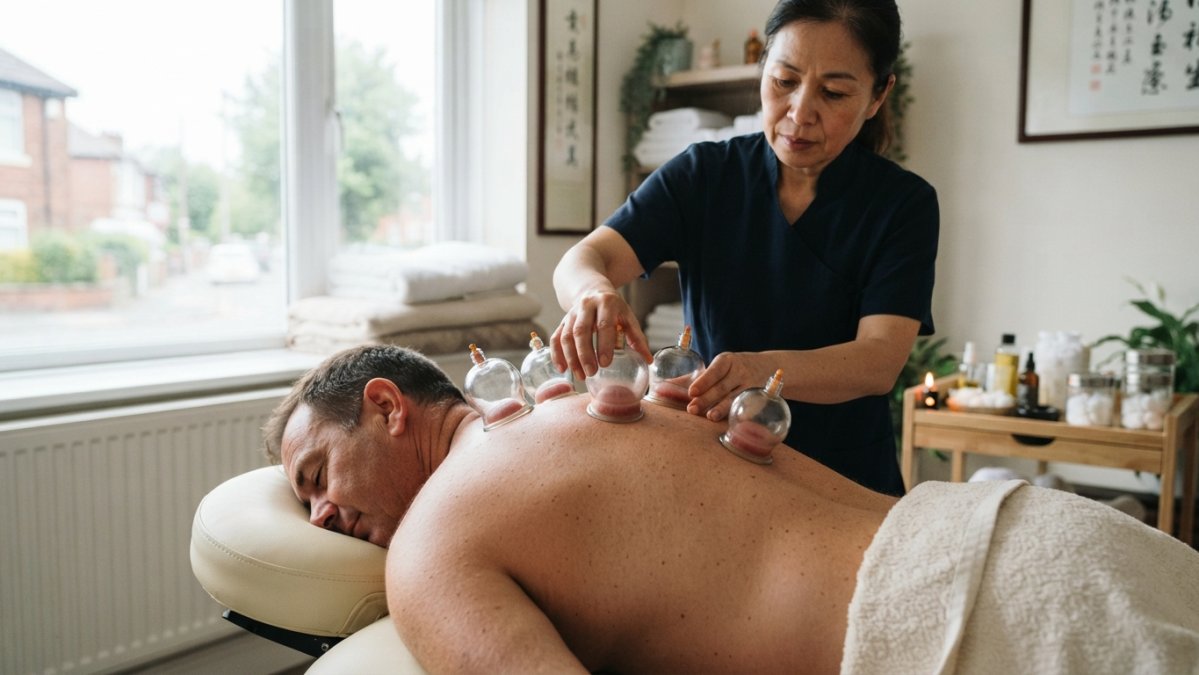
The sensation is a firm pull rather than a sharp pain. Most people describe it as intense but tolerable, and it eases as the session settles. Marks are common and usually fade over several days.
That mark is the part nobody explains properly. It is not bruising in the injury sense, and it is not a sign of how "toxic" you were. It is a temporary response in the skin.
Athletes often combine cupping with hands-on work rather than using it alone.
Tui Na Massage in Hull: A Hands-On Option for Musculoskeletal Pain
Tui Na massage in Hull suits people who want pressure and movement rather than relaxation. It is a structured, clothed treatment using pressing, rolling, and joint mobilisation along channels and muscle groups.
Where it earns its place is in recurring shoulder, neck and lower back complaints. If you are coming from sports massage, expect firmer and more directional work, with attention to the whole limb rather than one tender spot.
It is not a gentle spa massage, and we say that up front. Some people want that. Others book expecting it and are surprised.
Recurring injuries rarely resolve from one session. A short course with a clear review point is the honest way to test whether it helps you.
Chinese Medicine in Hull: How It Fits Alongside NHS Care
Chinese medicine in Hull works best as an addition to NHS care, not a replacement for it. Nothing we do should delay a diagnosis, a scan, or a referral.
That boundary is not a formality. If you have unexplained weight loss, new neurological symptoms, or pain that is worsening despite treatment, your GP comes first. Complementary therapy can run alongside that process once serious causes are excluded.
Where the two fit together well is in long-term management: pain that has been investigated and is not improving, sleep disruption, stress-related tension, and rehabilitation support.
The NICE guidance on low back pain and sciatica is clear that exercise and structured programmes form the core of management. We see hands-on therapy as supporting that core, not competing with it.
How to Choose a Golden Health Alternative in Hull
Choosing a golden health alternative in Hull comes down to matching the treatment to your actual problem, then checking the practitioner is properly trained, insured and honest about limits.
Use this checklist before you commit:
- Confirm the clinic can explain its council registration position
- Ask for the practitioner's qualification and professional body
- [ ]
- Check the first appointment includes a full assessment
- Ask what a fair trial of treatment looks like, and when to stop
- Confirm the clinic will liaise with your GP with consent
- Ask how pricing works before the course begins, not after
On cost, we will not quote a figure here because it depends on the treatment, the session length and the course length. Ask any clinic directly for its current pricing and what a course includes. A clinic that cannot answer that clearly is worth a second thought.
Our own approach at Lee Chinese Style Therapy Ltd is built around assessment first: we would rather tell you we are not the right option than take a booking that will not help. You can book a consultation and we will talk through your history before anything is agreed.
Conclusion
The hardest part of this decision is not finding a clinic. It is being honest about what you want the treatment to do, and whether the evidence and the practitioner support that. Most people who end up disappointed skipped that step.
If you want a proper assessment before committing to a course, Lee Chinese Style Therapy Ltd offers consultation-led care across acupuncture, Tui Na massage, cupping and the wider range of traditional Chinese medicine. We assess first, explain the limits honestly, and build a plan around your condition rather than a fixed package. Book a consultation and we will tell you plainly whether treatment is likely to help.
Frequently Asked Questions
What alternatives to Golden Health are available in Hull?
Hull has a mix of independent complementary therapy clinics offering acupuncture, cupping therapy, Tui Na massage and other traditional Chinese medicine treatments, alongside NHS and private GP services. When comparing a golden health alternative in Hull, look at what each clinic actually offers, who delivers the treatment, and how easy it is to reach from your part of East Yorkshire. Ask about session length, what a course involves and whether the practitioner works with your specific concern. Booking a consultation first lets you judge suitability before committing to a course.
How do I compare acupuncture clinics in Hull?
Start with the practical details: location and travel time, opening hours, and whether appointments are available when you need them. Then check the practitioner's training, and ask how many sessions they expect your concern to need. Compare what is included in each session and how the clinic handles reviews and follow-up. For acupuncture in Hull, a short consultation before treatment is a fair way to test whether the practitioner listens and explains their approach clearly. Do not rely on review counts alone.
What should I ask before booking acupuncture or cupping therapy?
Ask what qualifications the practitioner holds, what the session involves, and how many sessions they suggest for your concern. For cupping therapy in Hull, ask how marks typically look and how long they last, plus any aftercare advice. Tell them about medicines you take, particularly blood thinners, and any skin conditions. Ask what results are realistic and what happens if the treatment does not help. A reputable clinic answers these plainly and never guarantees a cure.
How can I check whether a complementary therapy is suitable for me?
Suitability depends on your health history, medicines and the concern you want help with. Speak to your GP first if you have a long-term condition, are pregnant, or take anticoagulants, and mention any therapy you are considering. Then discuss it at a consultation with the practitioner, who should ask about your medical history before treating you. For Chinese medicine in Hull, ask how the practitioner coordinates with your NHS care and whether they would advise pausing treatment. No therapy suits everyone, so an honest conversation about risks matters more than a quick booking.