 how-to
Acupuncture for Chronic Neck Stiffness: A Practical Guide
Table of Contents
- Acupuncture for Chronic Neck Stiffness: What to Expect
- How Long Does Acupuncture Take to Work for Neck Pain?
- Acupuncture Points for Neck Stiffness: A Practical Map
- Acupuncture for Neck and Shoulder Pain: Tension That Travels
- Acupuncture for Neck Nerve Pain: What It Can and Cannot Do
- Acupuncture Compared with Exercise, Physiotherapy, Medication and Usual Care
- Self-Acupressure for Neck Stiffness: Landmarks and Safety Limits
- Safety, Side Effects and When to Seek Medical Care
- Frequently Asked Questions
Last Updated: October 18, 2026
Acupuncture for Chronic Neck Stiffness: What to Expect
Chronic neck stiffness is tightness, heaviness or restricted movement in the neck that has lasted more than three months, often with pain that spreads into the shoulders.
Here is what most guides get wrong. They treat a stiff neck as one problem. It is not. A locked neck after a bad night's sleep and a neck that has ached for two years need very different plans.
Acupuncture sits within traditional Chinese medicine, and current guidance from the National Institute for Health and Care Excellence places it among the options considered for some persistent pain. It is not a cure, and it does not suit everyone.
What you can expect from a first appointment:
- A review of your history, posture and movement
- A hands-on check of the neck, shoulders and upper back
- A short, targeted needling session
- A written plan covering sessions, frequency and home care
How Long Does Acupuncture Take to Work for Neck Pain?
Most people notice some change within two to four sessions, but the honest answer is that timing varies. Acute flare-ups often settle faster than long-standing stiffness. Chronic neck pain tends to respond slowly and unevenly, and gains usually build across a full course.
A common mistake is judging the treatment after one session. Muscles that have been guarded for months do not release in a single visit.
What shapes your timeline:
- How long you have had it. Years of stiffness takes longer than weeks.
- How much you move. Desk-bound days slow progress.
- How consistent you are. Weekly sessions early on work better than sporadic ones.
- Your overall health and sleep. Poor sleep and high stress blunt the response.
A realistic session-by-session timeline
A common pattern for chronic neck stiffness looks like this:
- Sessions 1-2: Assessment, first needling, and a baseline score. You may feel looser for a day or two, then stiffen again. That is normal.
- Sessions 3-4: The first honest checkpoint. If nothing has shifted at all, we change the point selection or add cupping or Tui Na rather than repeating the same needling.
- Sessions 5-6: Most people who respond show a clear trend by now, easier turning, less morning stiffness, better sleep. If there is no trend, we discuss whether acupuncture is the right tool for you.
- Sessions 7-10: Consolidation. Sessions may space out to fortnightly as home exercises and self-acupressure take over.
We ask patients to score pain and stiffness before each session. That record tells us more than memory does. A simple 0-10 score for pain at rest, pain on movement, and stiffness on waking takes under a minute and gives us a trend line.
How to measure meaningful improvement
Pain scores alone miss the point. Track four things weekly:
- Pain at rest and on movement (0-10)
- How far you can turn your head each way
- Sleep quality
- How much the stiffness interferes with work or daily tasks
A drop of two points on a 0-10 scale, or being able to turn your head further before pain starts, is a meaningful signal. Chasing a zero is unrealistic for long-standing stiffness; chasing function is not.
Acupuncture Points for Neck Stiffness: A Practical Map
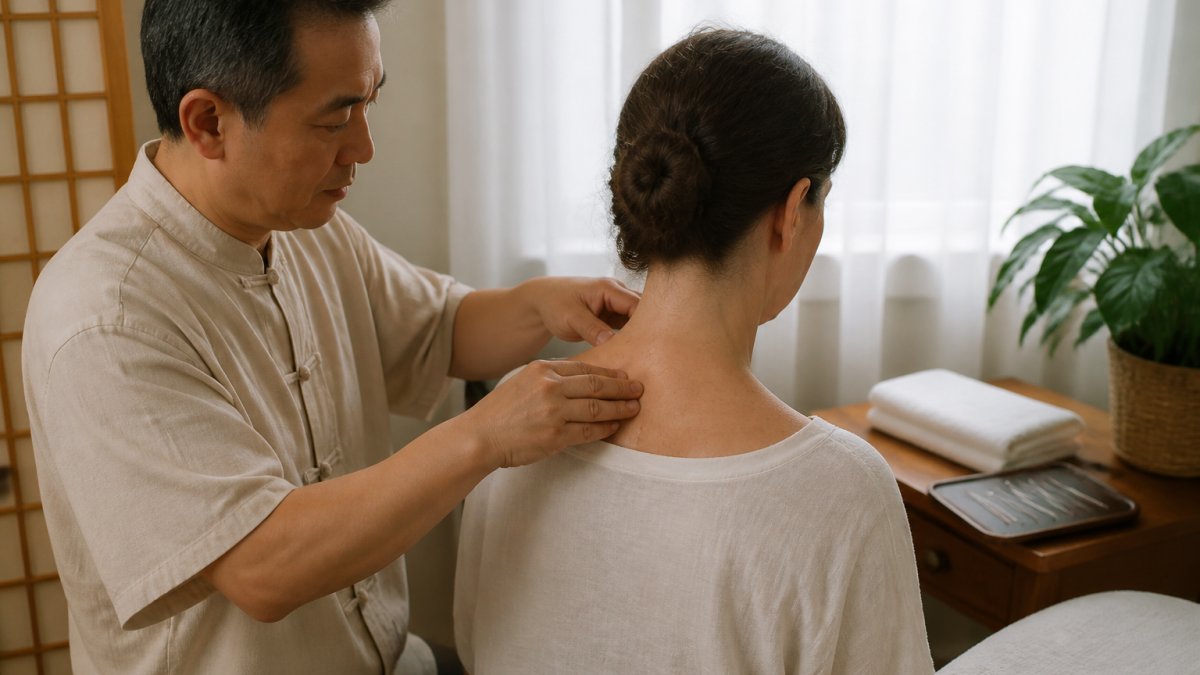
Acupuncture points for neck stiffness are specific spots chosen from a wider map of acupoints, and the ones used depend on where your tension sits. A good practitioner does not follow a fixed list. They press, watch your reaction and treat the points that feel tender.
Points commonly used around the neck and shoulders:
- GB20 (Feng Chi, "Heaven's Pillar"), in the hollows at the base of the skull, either side of the spine, where the neck muscles attach. Needled towards the opposite eye, shallowly.
- GB21 (Jian Jing), midway between the base of the neck and the tip of the shoulder, on the highest point of the trapezius. Needled perpendicularly, but never deeply in pregnancy.
- SI 3 (Houxi), on the outer edge of the hand, in the hollow just behind the knuckle of the little finger when a loose fist is made.
- TE3 (Zhong Zhu), on the back of the forearm, in the hollow between the two forearm bones, about a hand's width above the wrist.
- LI 4 (He Gu), in the web between thumb and index finger, on the fleshy mound when the thumb is tucked in. Avoid in pregnancy.
How points are chosen
Tender spots matter more than textbook positions. If a point feels sharp or bruised when pressed, that is a signal to treat it. Practitioners often combine three groups:
- Local points at the neck and shoulder (GB20, GB21) to release guarded muscle
- Distal points on the arm and hand (SI 3, TE3, LI 4) to influence the channel that runs through the neck
- Ah Shi points, tender spots that are not classical points but respond well to needling
What needling actually involves
Needles are fine, typically 0.16-0.25 mm in diameter, and inserted 5-20 mm depending on the point. GB20 is needled shallowly and angled; GB21 perpendicularly but with care to avoid the lung field below. A dull ache, heaviness or spreading sensation (called de qi) is the intended response, not sharp pain. Needles usually stay in for 15-25 minutes.
Acupuncture for Neck and Shoulder Pain: Tension That Travels
Neck and shoulder pain rarely stay separate. The upper back, shoulder blade and neck share muscles and nerve pathways, so tension in one area pulls on the others. Treating the neck alone often leaves the shoulder still tight.
We look at the whole chain: base of the skull, shoulder blade, upper back and chest. Tight chest muscles pull the shoulders forward, which loads the neck.
What this means in practice:
- Treating the shoulder blade often eases neck pain
- Posture work sits alongside needling, not after it
- Tui Na massage and cupping can complement acupuncture when muscles are very guarded
Acupuncture for Neck Nerve Pain: What It Can and Cannot Do
Acupuncture for neck nerve pain is a supporting treatment, not a standalone answer. Nerve-type pain, such as shooting pain down the arm, numbness or tingling, needs proper assessment first. It can signal a trapped nerve or disc problem that requires medical review.
What acupuncture may help with:
- Easing surrounding muscle tightness that adds pressure
- Improving comfort and sleep
- Supporting your tolerance of movement and exercise
What it cannot do:
- Repair a damaged disc
- Replace medical assessment for weakness or numbness
- Guarantee a fix for nerve pain
Acupuncture Compared with Exercise, Physiotherapy, Medication and Usual Care
Acupuncture works best alongside movement, not instead of it. Exercise and physiotherapy build strength and control. Medication eases pain short-term. Acupuncture targets muscle tension and pain signalling. Usual care, such as heat and activity advice, is the baseline everyone should keep.
| Approach | Main Strength | Main Limit | Best Used With |
|---|---|---|---|
| Acupuncture | Eases tension and pain | Needs a course | Exercise, posture work |
| Exercise | Builds lasting strength | Slow to start | Acupuncture, physio |
| Physiotherapy | Corrects movement faults | Needs commitment | Home exercises |
| Medication | Quick short-term relief | Side effects, no fix | Short-term only |
| Usual care | Simple and free | Limited on its own | Everything above |
Our view is blunt: needles without movement change little. Movement without pain relief is hard to sustain. Pair them.
Self-Acupressure for Neck Stiffness: Landmarks and Safety Limits
Self-acupressure is pressure applied with your fingers to the same points a practitioner would needle, and it is a sensible daily add-on. It will not replace treatment, but it keeps muscles from re-tightening between sessions.
How to do it:
- Find GB20 in the hollows at the base of your skull, either side of the spine.
- Press gently with two thumbs for 30 to 60 seconds.
- Move to GB21 on top of each shoulder and press for 30 seconds.
- Use LI 4 in the web of the hand for 30 seconds per side.
- Breathe slowly and keep the pressure firm but never sharp.
Safety limits:
- Stop if you feel dizzy, sick or numb
- Avoid pressing the front of the throat
- Do not press hard on a painful, swollen or injured area
- Skip it if you are pregnant without checking with a clinician first
Safety, Side Effects and When to Seek Medical Care
Acupuncture is generally well tolerated when delivered by a trained practitioner. Minor side effects are common and short-lived: small bruises, mild soreness at needle sites, or brief drowsiness. Serious problems are rare.
When to seek medical care rather than treatment:
- Neck pain after a fall or accident
- Weakness, numbness or loss of grip in the arm
- Severe headache with a stiff neck and fever
- Trouble swallowing, speaking or breathing
- Pain that keeps worsening despite care
If you are unsure, get checked. We would rather turn someone away than treat a problem that needs a doctor.
A practical plan for chronic stiffness:
- Book an assessment and describe your history clearly
- Commit to a short course, weekly at first
- Do daily self-acupressure and gentle movement
- Track pain and stiffness scores each week
- Review progress after four to six sessions
If you have tried physiotherapy, osteopathy and injections without lasting change, a fresh approach is reasonable. Book a consultation with Lee Chinese Style Therapy Ltd and we will assess your neck honestly, explain what acupuncture can and cannot do, and build a plan around your goals.
Frequently Asked Questions
Can acupuncture help chronic neck stiffness?
Acupuncture is used for chronic neck stiffness and related mechanical neck disorders, with some clinical studies reporting reduced pain intensity and improved range of motion. It is not a guaranteed cure, and response varies. Many people notice easing of stiffness within the first few sessions, while others need a longer course. Because chronic stiffness often involves posture, work habits and muscle guarding, acupuncture is best combined with movement, ergonomic changes and, where appropriate, physiotherapy. A qualified practitioner should assess you first and explain realistic goals.
How long does acupuncture take to work for neck pain?
Some people feel a change in stiffness or pain within 24 to 48 hours of a session, while others notice a cumulative effect after three to six sessions. For chronic neck pain, a common pattern is weekly sessions for several weeks, then spacing them out as symptoms settle. If there is no meaningful change after a short course, the plan should be reviewed rather than extended indefinitely. Track pain intensity, how far you can turn your head and how stiffness affects sleep or work so progress is measured, not guessed.
Is acupuncture good for neck nerve pain?
Acupuncture is sometimes used alongside conventional care for neck-related nerve pain such as burning, tingling or pain travelling into the arm. Evidence is mixed and it should not replace a proper diagnosis, especially if you have weakness, numbness or loss of grip. Nerve pain can have causes that need medical assessment, including disc problems or narrowing in the neck. If acupuncture is appropriate, it is typically part of a broader plan that may include physiotherapy and medication. Seek medical advice promptly for new or worsening neurological symptoms.
What should I expect during an acupuncture session for neck stiffness?
A first appointment usually includes a discussion of your history, neck movements and areas of tenderness, followed by fine needles placed at selected points around the neck, shoulders and hands. You may feel a brief dull ache or heaviness. Needles typically stay in for around 15 to 30 minutes while you rest. Some people feel relaxed afterwards, others slightly tired. Mild soreness at needle sites can occur. Tell your practitioner if you take blood-thinning medication, are pregnant or feel unwell, and never self-treat with needles.